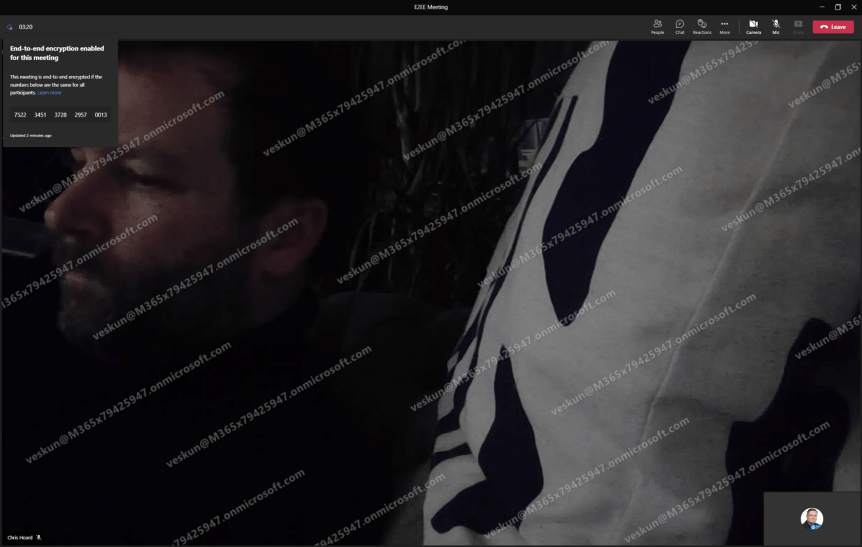
Following yesterdays blog on Watermarking let's turn to another premium feature. End to End Encryption (E2EE) has been around for 1:1 VOIP calls for a while. I once did a blog on it. I even spoke about it a few times including at aMS Lausanne where I covered how to implement it, the caveats, and how DTLS over SRTP worked. So, with the coming of Teams Premium, we now have E2EE for Meetings. Excellent. And like VOIP calls caveats do apply. Let's run through them. Number 1:Like VOIP calls, E2EE for Meetings only covers real time media. In other words, only audio and video and screen sharing are encrypted at the source and decrypted at the destination without any nodes or parties decrypting/re-encrypting in between. Everything else – chat, files, avatars, reactions, Q&A presence, are not end to end encrypted. - however importantly these other things are still TLS encrypted as part of the standard service encryption. This is a question you may be commonly asked, and it confuses people because what is EE2E and what is not E2EE is on the same screen, in the same app. Number 2: Like VOIP calls, in an E2EE meeting many familiar features will be unavailable to you - no together mode, or live captions, or recording or breakout rooms, or CART options, or language interpretation. This is minimalist meeting designed for private communications which, like VOIP calls it also nixes compliant call recording and all orgs/users who use CCR because the compliant call recording can't access what it needs and EE2E will not override this compliance requirement. Number 3: Unlike when VOIP calls were first introduced, this can be managed in the TAC. Number 4: Like VOIP calls, E2EE isn’t enabled even after enabling it in the TAC - it requires enabling in the meeting options but good news is that unlike VOIP calls you don't have to enable it in the client settings, and you can auto-enable it via Teams Meeting Templates and Sensitivity Labels. Number 5: Its available between two parties when the parties are using the latest version of the Teams desktop client for Windows or Mac, they are on a mobile device with the latest update for iOS and Android, or they are on a Teams Rooms on Windows device using the latest update and the mobile app. It’s not currently supported in web, nor VDI. So this is a continued phasing out and pretty consistent with the VOIP experience. One final thing - the meeting organiser, the one who schedules the E2EE meeting needs Teams Premium: not everyone needs a Teams Premium licence

 @Microsoft365Pro