
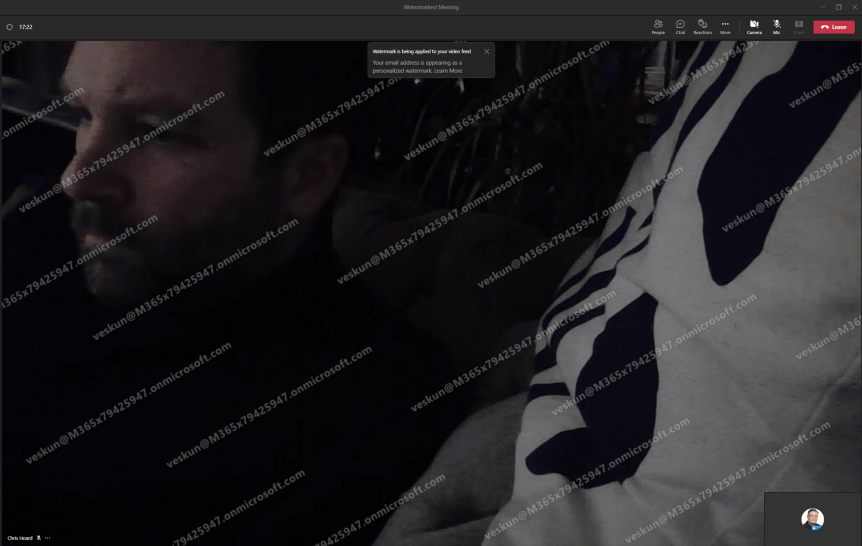
Meetings, like files, can contain sensitive information. Whether sharing video, or sharing screen content such as a PowerPoint presentation, the meeting organiser may wish to actively discourage data leakage, counterfeiting or plagiarism. Think of the following scenario: an attendee screenshots a PowerPoint slide whose intent is to leak that onto others even knowing that the content has been explicitly defined by the presenter as being under NDA. This is where watermarking fits in. A watermark, by definition, is an identifying image or pattern that appears as various shades of lightness/darkness when viewed by transmitted light. The process originated over 800 years ago and has been used for paper, stamps and currencies. In IT, it is defined as a piece of transparent text, image or logo, applied to an item, such as a file, an image, or a video. In Microsoft 365 watermarking can be used in Office apps, such as Word (via the Design Tab) or can be automatically applied to files via Sensitivity Labels. With the coming of Teams Premium, watermarking can now be used in Teams meetings for both video and shared content, and can be used in alignment with other Teams Premium functionalities such as Meeting Templates and Meeting Sensitivity Labels. This is awesome, and these functionalities will be explored in forthcoming blogs. But at the time of writing, there are some rules around watermarking which I would advise need to be known before going ahead and using it with confidence. This is a bit like when End to End Encryption (EE2E) was released. Firstly: if using watermarking, you cannot record. Not manually, not automatically whether that is sharing video or content. Secondly, it knocks out other meeting functionalities such as Together Mode, Large Gallery, PowerPoint Live and Content from Camera. This depends on what you watermark. Third, if watermarking is used, then it would be an audio experience only for web, VDI (so on AVD/Win 365) as well as anonymous and overflow participants and again this depends on the watermarking. Last - and the big one, the watermark itself displays the the email address of the meeting participant, not the presenter. I have already been asked why this is - and to be fair it makes a lot of sense. If somebody leaks your content, then it's not going to really identify who did that by having your details on it. If some screenshot gets out into the wild then it'll have their details stamped all over it, or it's going to cause them an incredible amount of difficulty to try and gloss over the watermarks. I am quite excited to try this out
Category: Microsoft Teams
12 features I would like to see land in Microsoft Teams in 2023

2022 went fast. This is the 4th year I have written this article but honestly? It feels like I wrote the last one yesterday. And here we are at the other side of the pandemic; in what still feels like turbulent times. In 2022 we've seen the Ukrainian-Russian conflict, it's terrible impact on millions of lives as well as its subsequent impact on the global economy. We've seen the growing political tension between China and the West. Natural disasters like the flood in Pakistan or more evidence of climate change - record breaking heatwaves and widespread wildfires such as the ones in Portugal or Spain over the summer. The overturning of abortion rights in Texas. Musk and Twitter. Iran. Afghanistan. It's easy to get caught up in the doom and gloom of it all. And occasionally we need to be reminded of the good things. In 2022 we are closer to fusion power than ever before. We have more people working in hybrid than ever before. As this nice article in Wired illustrates, there are numerous examples which don't always seem to grab so many headlines: in the US renewables generated more energy than nuclear and coal for the first time. There has been progress on the treatment of Alzheimer's. The successful test of the DART program to protect our planet against impact events. For people who worry about climate change, Scientific American reported that the global growth in renewables alone is estimated to have likely avoided 600 million tons in additional CO2 emissions, or slightly less than the 646 million tons of CO2 produced by Germany last year.
Teams Real Simple with Pictures: User Controlled Busy on Busy

Microsoft Teams was recently named a leader in the Gartner Magic Quadrant for Unified Communications for 2022 - and with good reason. Let's take a look at the stats: 80 million users of Teams Phone. 12 million users of PSTN. Calling Plans expanding from 28 to 34 countries, and a voice SLA now standing at 99.99%. Over the last year or two Microsoft has continued to introduce many new innovations to the calling service such as Operator Connect, Operator Connect Mobile, SIP Gateway, Survivable Branch Appliance, a new PSTN desk with integration into the Teams Admin Centre, as well as several useful features ranging from the customization of call parking, to surfacing end-user call routing in the TAC. Having recently attended Airlift, I can confirm there is so much cool stuff still to come. The journey is far from over. But being under NDA I have to suppress my excitement for a while longer. But in the meantime, I was interested to see that user controlled busy on busy has shipped into preview the past few days. But what is Busy on Busy? By definition Busy on Busy lets you configure how incoming calls are handled when a user is already in a call or meeting or has a call placed on hold. New or incoming calls - for VOIP or PSTN - can be rejected with a busy signal or can be routed accordingly to the user's unanswered settings. Up until now - since Busy on Busy was introduced, this functionality has been set by the administrator, but the user can now decide for themselves how the incoming call is handled - or periodically change that on the fly.
Teams Real Simple with Pictures: Surfacing Stories within Viva Engage
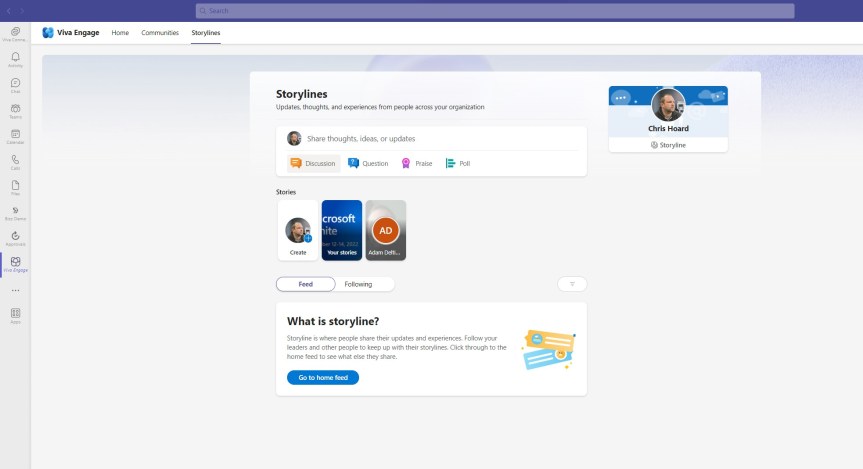
After a few weeks of focussing on the transition to Infinigate and inner ring preview testing for various product teams at Microsoft, I don't mind telling you that it's mighty fine to be back with some bandwidth for doing the blog. I wish I could tell you that I have had some iota's worth of break during that time, but that would be a barefaced lie. My world has been consumed by DevOps, and Sprints, and scrutinizing UX, and the H1 schedule and programmatic changes such as Solution Partner Designations. But if you have followed this blog for any length of time, then you know that I think having a few weeks away every so often is typically a good thing. Absence makes the heart grow fonder and all. But in the world of cloud the bucket of content fills back up. So, this week I am going to talk about something which I don't often cover - and that is Viva Engage. Viva Engage, by definition, is a new employee experience that connects people across the company. It is driven by Yammer services to which Yammer is a part. It is also in the second wave of Viva apps of which we would also bucket Pulse, Amplify, Goals, Sales and all the others announced this year. Now, the functionality we will be specifically looking at today is called Stories. Stories - again, by the only definition I could find, is a 'modern, engaging way to capture the moment, with short videos or photos that are showcased in a stories carousel'. Think of content similar to Tik Tok and Insta ((videos and pictures) that followers of your own Storyline can view and engage with, and which your provide them as a richer experience. So, basically, something way out of my comfort zone but something I am looking to use in my own organisation
Teams Real Simple with Pictures: RTMP Streaming into YouTube
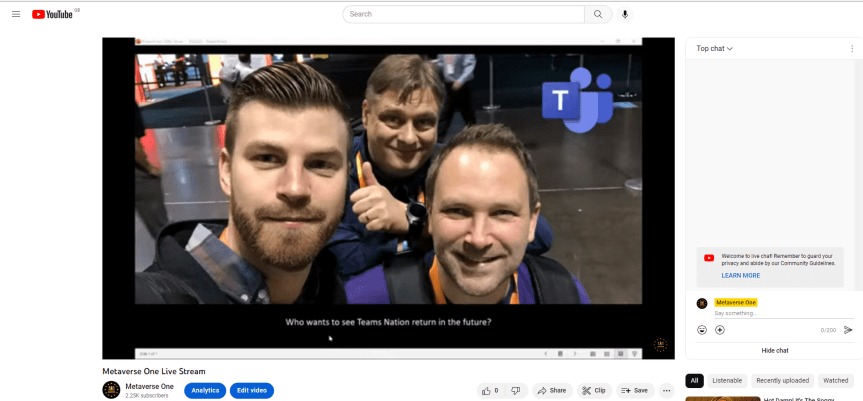
Another crazy week for what has turned out to be another crazy year. But last Friday I officially started what I am calling a 'sabbatical' and taking some time out from frontline teaching and speaking until at least the end of January. On the one hand, there is a ton of work to be done regarding a recent merger. I have a list of DevOps tasks literally as long as my arm which includes loading out for H2. On the other hand - and after several months of big deliveries - I wanted some time away from the coalface and to have a breather. Anyone who does teaching or speaking regularly knows there is a lot associated with that. So, a break is needed. And by break, that means pivoting to things which are more transactional such as my DevOps tasks, preview testing for Microsoft and this blog. So, this week I am going to discuss how to stream a Teams Meeting to YouTube. It's something I really should have done months ago, but somehow, I always never got around to it. But it feels the right time, and there are a ton of reasons to use custom streaming. Breath of audience, different audience, different surface. If you think about it, something like 2 billion use YouTube so that goes well beyond the limits of a live event. And to be honest, it's not a difficult setup - and neither is it an on or off switch so you can easily configure it for those who need it. What's not to like? Let's talk about Real Time Messaging Protocol (RTMP)
 @Microsoft365Pro